Types of Solar Panels
Solar panels are at the heart of renewable energy adoption, helping homes, businesses, and industries harness the power of the sun. While they may look similar on rooftops or solar farms, not all solar panels are the same. Different technologies exist, each with unique characteristics, efficiency levels, and applications. Understanding the types of solar panels is important for choosing the right one based on energy needs, budget, and location.
1. Monocrystalline Solar Panels
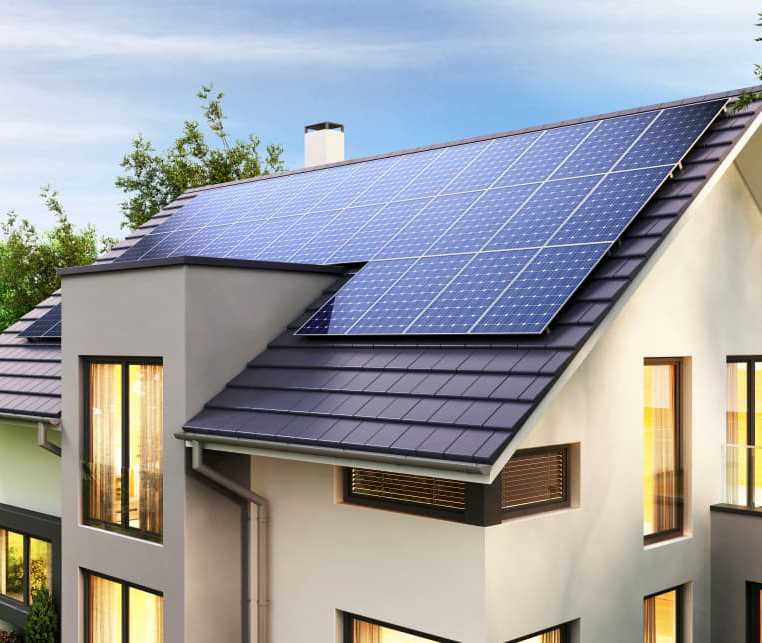
Monocrystalline panels, also known as mono panels, are the most common and recognizable type. They are made from a single crystal structure of silicon, which gives them their characteristic uniform dark color and rounded cell edges.
-
Efficiency: These panels are highly efficient, typically ranging from 18% to 22%, meaning they convert more sunlight into electricity compared to other types.
-
Advantages: They require less space, perform better in low-light conditions, and have a long lifespan of 25 years or more.
-
Disadvantages: Their main drawback is cost. Since they are made from high-purity silicon, the manufacturing process is more expensive.
-
Best suited for: Homes and businesses with limited roof space but high energy needs.
2. Polycrystalline Solar Panels
Polycrystalline panels, often called poly panels, are made from multiple silicon crystals melted together. This gives them a distinctive speckled blue appearance.
-
Efficiency: Their efficiency is lower than monocrystalline, usually between 15% and 17%.
-
Advantages: They are cheaper to produce, making them more budget-friendly.
-
Disadvantages: They require more space to produce the same amount of energy as mono panels and are slightly less efficient in high temperatures.
-
Best suited for: Projects where space is not a major concern and cost savings are important, such as large solar farms.
3. Thin-Film Solar Panels
Unlike crystalline silicon panels, thin-film solar panels are made by placing thin layers of photovoltaic material (such as cadmium telluride or amorphous silicon) onto a surface like glass, plastic, or metal. They are lightweight and flexible, which makes them different from traditional panels.
-
Efficiency: They generally have lower efficiency, around 10% to 13%, but advances are improving performance.
-
Advantages: Easy to install, lightweight, and work better in high temperatures compared to crystalline panels. They also look sleek and uniform.
-
Disadvantages: They take up more space, degrade faster, and typically have shorter warranties.
-
Best suited for: Large-scale projects, commercial rooftops, or specialized applications like building-integrated photovoltaics (BIPV).
4. Passivated Emitter and Rear Cell (PERC) Panels
A modern improvement on monocrystalline technology, PERC panels include an additional layer on the back of the solar cell. This layer reflects unabsorbed sunlight back into the cell, allowing it to generate more energy.
-
Efficiency: Can reach above 22%, making them one of the most efficient options available.
-
Advantages: Higher energy generation in the same space, better performance in low-light and high-temperature conditions.
-
Disadvantages: Slightly more expensive than standard mono panels.
-
Best suited for: Residential and commercial installations where maximizing energy in limited space is crucial.
5. Emerging Solar Panel Technologies
The solar industry is constantly evolving, and new technologies are under development:
-
Bifacial Panels: Capture sunlight from both the front and back sides, increasing energy output.
-
Solar Tiles/Shingles: Integrated into rooftops, offering aesthetic appeal along with functionality.
-
Perovskite Solar Cells: A promising new material that could deliver very high efficiency at lower costs, though still in the research phase.
Conclusion
Solar panels come in different types, each with its own strengths and weaknesses. Monocrystalline panels offer high efficiency and durability, while polycrystalline panels provide an affordable option. Thin-film panels bring flexibility and lightweight design, while PERC technology pushes efficiency even further. Emerging options like bifacial panels and solar shingles promise even more exciting possibilities for the future.
Choosing the right solar panel depends on factors such as budget, available space, energy needs, and aesthetic preferences. By understanding the differences, individuals and businesses can make smarter decisions and maximize the benefits of solar energy.